
More Than Doctrine: The Shared Way of Life That United the Early Church (Part 2/2)
Author: Stef Miles
Acknowledgement: I owe a debt of gratitude to my friend Michael Hardin, whose scholarship first highlighted the insight explored in this article.
The Common Discipleship Ethic
So what did this shared way of life actually look like?
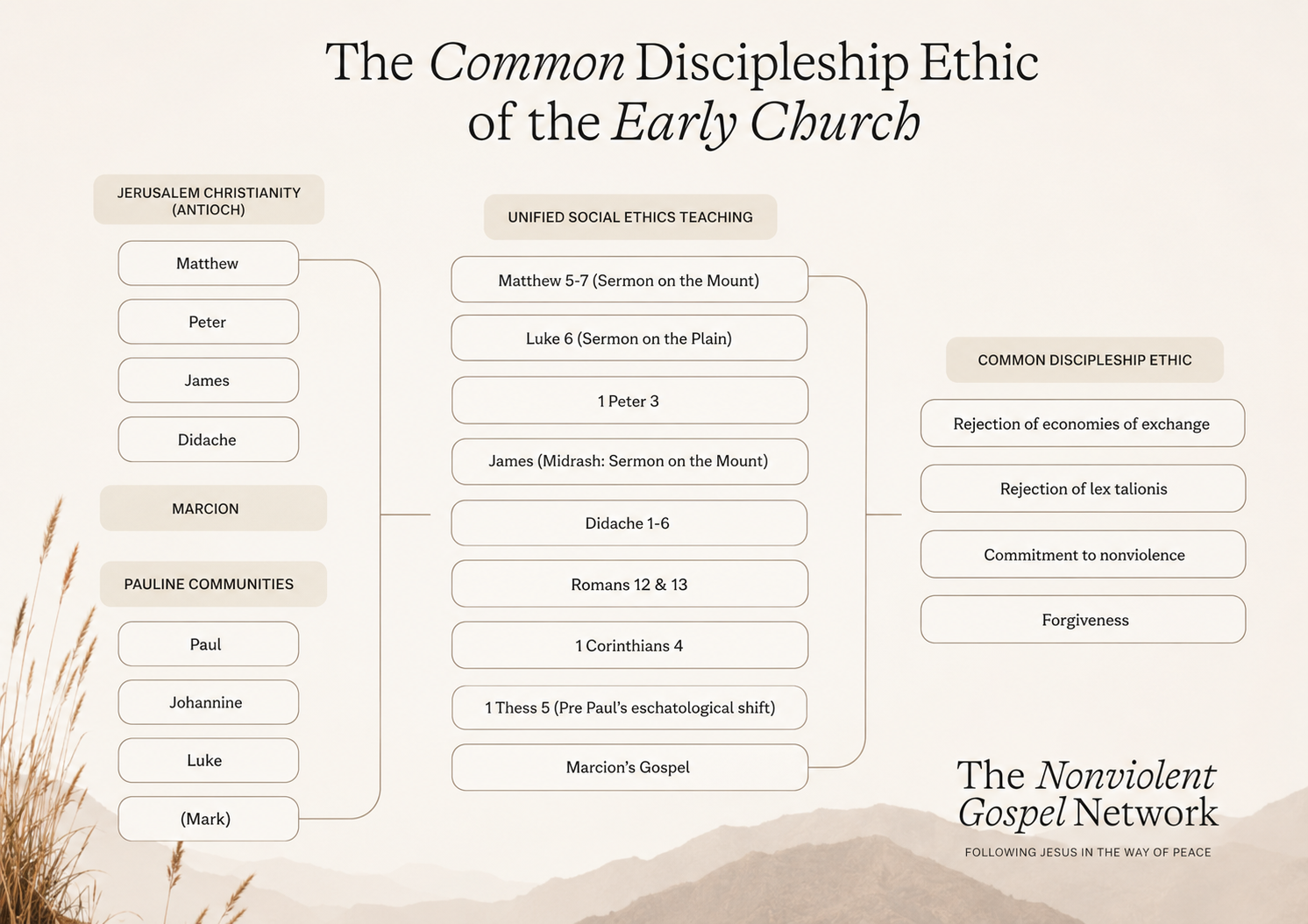
Across these different texts and communities, I think we can broadly distil it into four interconnected commitments: the rejection of economies of exchange, the rejection of lex talionis, a commitment to nonviolence and radical forgiveness.
Rejection of Economies of Exchange
Much of human society operates according to economies of exchange:
"I will be kind if you are kind to me."
"I will love those who love me."
"You've bought me a gift, so now I feel obligated to buy you one in return."
We know this logic well. Much of our social world is built upon it. Jesus rejects it.
Love is not a transaction. Grace is not earned. Forgiveness is not exchanged for good behaviour. The disciple gives because God gives.
Rejection of Lex Talionis
Lex talionis means "the law of retaliation", often summarised as "an eye for an eye and a tooth for a tooth."
Jesus moves beyond retaliation altogether. Rather than returning harm for harm, disciples are called to break the cycle of revenge.
Someone has to refuse to return what they have received.
Commitment to Nonviolence
The earliest Christian communities consistently inherited Jesus' commitment to overcoming evil without violence. This was not passivity or weakness.
Quite the opposite.
It was the conviction that evil could be confronted without becoming its mirror image, and that God's purposes are achieved through self-giving love rather than coercion and force.
Radical Forgiveness
Forgiveness stands at the centre of the Gospel.
Jesus forgives his executioners from the cross and returns to his fearful disciples after the resurrection not with vengeance, but with peace.
Think about that for a moment. The crucified victim returns to those who abandoned and denied him, and his first word is peace.
The early church understood forgiveness not as an optional virtue for particularly saintly Christians, but as a defining mark of Christian identity.
How the Early Church Formed Disciples
There is another aspect of the early church that I think deserves our attention. Because modern Christianity has, in many ways, reversed the process of discipleship.
In many churches today, a person first hears a proclamation of the Gospel, responds in faith, is baptised, participates in the Eucharist and only then begins the process of discipleship.
The assumption is often that discipleship follows conversion. And perhaps this modern sequence reflects a Gospel that has itself become reduced to a transaction:
Jesus died for your sins. Accept this gift. Receive salvation.
The earliest church appears to have operated very differently.
Scholars such as Aaron Milavec and Alan Kreider have shown how, particularly as the catechumenate developed during the first centuries of Christianity, discipleship was commonly understood as a lengthy process of formation into a distinctive way of life.
The first Christians did not primarily attract people through doctrinal arguments. They attracted people through the visible character of their communities. Outsiders encountered groups of people who cared for one another, shared possessions, forgave enemies, rejected retaliation and demonstrated a radically different way of being human. Those drawn to this life could enter a period of formation lasting several years. During this time they were not simply taught doctrines to believe. They were apprenticed into a new way of living.
Experienced Christians acted as mentors, guiding catechumens through the practical realities of discipleship.
They learned how to respond to hostility without retaliation.
How to bless those who persecuted them.
How to forgive when wronged.
How to resist participation in the cycles of violence, honour, shame and revenge that dominated the surrounding culture.
This wasn't merely classroom instruction. It was embodied formation within a community seeking to live the teachings of Jesus together.
Only after this prolonged period of learning, testing and transformation would a catechumen be baptised, admitted to the Eucharist and fully incorporated into the Christian community.
The difference is significant.
Today, churches often focus on helping people "make a decision" and then hope discipleship follows. The early church placed enormous emphasis on forming disciples whose lives increasingly embodied the teachings of Jesus.
The centre of the process was not numerical growth but transformation.
The goal was not simply to bring people into the church, but to form people into a community whose lives visibly reflected the Gospel they proclaimed. And this reinforces the wider argument.
If the earliest Christians invested years teaching converts how to love enemies, forgive offenders, reject retaliation and practise nonviolence, then these were hardly secondary matters. They were understood as essential expressions of faithfulness to Jesus.The shared discipleship ethic wasn't merely taught. It was patiently embodied, practised, mentored and handed on from one generation to the next.
Why This Matters Today
I don't think the significance of this shared ethic should be underestimated. The early church disagreed on many things. They debated theology, Scripture, the inclusion of Gentiles, the nature of God and the end of the age.
Yet across these differences we repeatedly find agreement on enemy love, forgiveness, non-retaliation and nonviolence.
That should tell us something.
If communities with different theological frameworks all preserved and practised these teachings, then they must have considered them essential to Christian discipleship. And this is where things become uncomfortable for us. Because in many churches today, these ethical teachings are often treated as secondary or optional. We can affirm the Sermon on the Mount while quietly assuming that Jesus can't really have expected us to live like that.
The earliest Christians appear to have thought otherwise.
For them, these practices were not merely moral advice added onto the Gospel. They were the practical outworking of the Gospel itself.
Whatever differences existed among the first Christians, they largely agreed on this: followers of Jesus are called to reject retaliation, refuse violence, forgive generously and love even their enemies.
That common discipleship ethic remains as challenging, and as necessary, today as it was in the first centuries of the church.
Perhaps the most important question for the church today is not whether we can recover the theology of the earliest Christians, but whether we can recover the discipleship ethic they shared.