
More Than Doctrine: The Shared Way of Life That United the Early Church (Part 1/2)
Author: Stef Miles
Acknowledgement: I owe a debt of gratitude to my friend Michael Hardin, whose scholarship first highlighted the insight explored in this article.
What United the Early Church?
When people talk about the early church, we can easily imagine a single, unified movement that believed the same things and practised the same faith everywhere. The reality is a little more complicated.
The earliest Christian communities were diverse. They wrestled with different questions, interpreted Scripture in different ways, and sometimes disagreed quite sharply with one another. Yet beneath these differences we find something remarkable: a common commitment to a shared way of life.
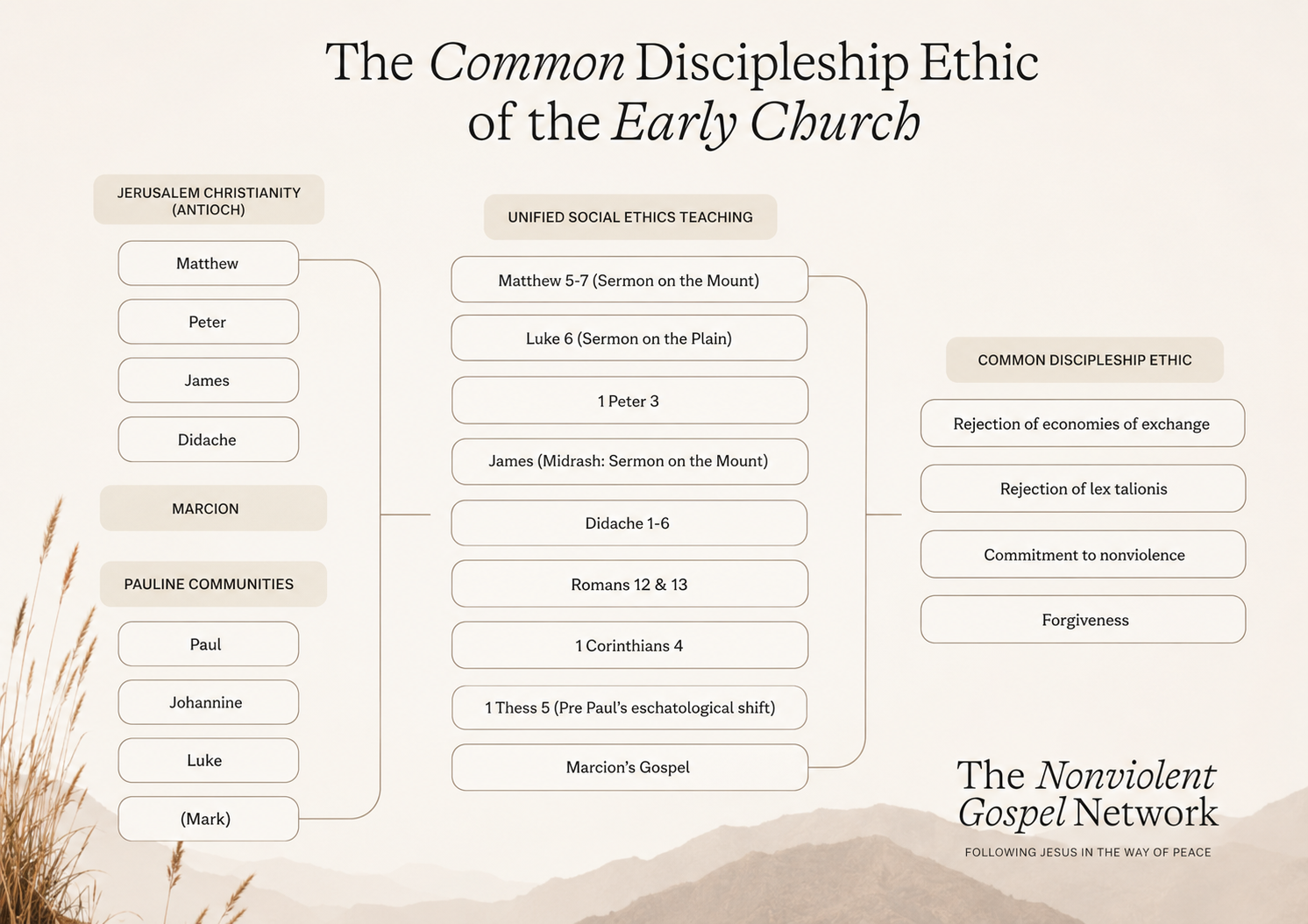
The chart Common Discipleship Ethic of the Early Church above highlights this reality. While early Christians were not always united in doctrine, they were remarkably united in discipleship. Across different communities, we repeatedly encounter the same social ethic: love of enemies, forgiveness, non-retaliation and the rejection of violence.
I think this matters.
Because what people are willing to disagree about tells us something. But what they refuse to compromise on tells us even more.
If Christians across quite different theological traditions continued to uphold the same practical ethic, then perhaps these teachings weren't secondary to the Christian faith.
Perhaps they stood at the very heart of what it meant to follow Jesus.
Different Communities, Shared Practice
Jerusalem Christianity
The earliest followers of Jesus emerged from within Judaism. Communities associated with Jerusalem, James, Peter, the Gospel of Matthew and the community that produced the Didache were all deeply shaped by Jewish traditions and practices.
One of their major challenges was working out how Gentiles could be included within God's people. Questions about circumcision, dietary laws and table fellowship became significant issues. Could Gentiles really belong without becoming Jewish?
Many of these communities also seem to have retained elements of Jewish apocalyptic expectation, including the belief that God would ultimately judge and defeat evil through acts of divine violence. For communities living through persecution, it isn't difficult to understand why such hopes might have offered comfort and reassurance.
Yet despite these theological assumptions, these communities consistently preserved and taught Jesus' commands to love enemies, forgive, bless persecutors and reject retaliation.
Marcion
Then there is Marcion, one of the most significant figures later declared heretical by the church. Marcion recognised a question many Christians continue to wrestle with today: how do we reconcile the God revealed in Jesus with portrayals of divine violence found in parts of the Old Testament?
It was, and remains, an important question. But Marcion arrived at the wrong conclusion.
He argued that the God revealed in Jesus was a different God from the creator God of Israel. In response, he rejected most of the Old Testament and produced an edited version of Luke's Gospel. The church rightly rejected this solution.
And yet, interestingly, even Marcion retained many of Jesus' teachings from the Sermon on the Plain, including the commands to love enemies, bless those who curse you and refuse retaliation.
Despite his theological errors, Marcion still recognised the central importance of Jesus' radical social ethic.
Pauline Communities
Paul's communities represented perhaps the most significant break from attempts to make Gentile believers conform to Jewish identity markers. For Paul, Gentiles did not need circumcision, dietary laws or other Jewish practices to belong fully within the people of God.
His letters increasingly present a vision of God revealed through self-giving love rather than violence, coercion or retribution. In passages such as Romans 12–13, 1 Corinthians 4 and 1 Thessalonians 5, Paul repeatedly calls believers to bless persecutors, refuse revenge, overcome evil with good and embody the cruciform life revealed in Jesus.
While Paul's theology differed in important ways from Jerusalem Christianity and Marcionite communities, his ethical vision remained strikingly similar.
Alongside Paul, the Johannine community appears to reflect a closely parallel trajectory. The Gospel and letters associated with John emphasise love, mutual indwelling, non-retaliation and the revelation of God's character in the self-giving love of Jesus. Although the theological vocabulary is distinct, the ethical shape is remarkably convergent with Paul's vision of cruciform love.
Recent scholarship has increasingly suggested that the Pauline and Johannine traditions were not simply isolated streams. They may have existed in some form of dialogue or indirect influence, sharing traditions, shaping overlapping networks of communities and reinforcing a distinctive non-retaliatory and love-centred discipleship ethic.
Different communities. Different theological frameworks.
And yet we keep encountering the same way of life.
The Unified Social Ethic
At the centre of the chart are several texts that demonstrate the shared ethical tradition embraced across these diverse communities.
Matthew 5–7: The Sermon on the Mount
Jesus teaches his followers to love their enemies, pray for those who persecute them, turn the other cheek, go the second mile and reject retaliation.
Luke 6: The Sermon on the Plain
Luke preserves many of the same traditions. Jesus calls his followers to love enemies, do good to those who hate them, bless those who curse them and refuse the cycle of revenge.
1 Peter 3
Believers are instructed not to repay evil for evil but instead to respond with blessing.
James
James repeatedly echoes the teaching of Jesus, particularly the themes found in the Sermon on the Mount. Many scholars have even described James as functioning almost like a commentary on Jesus' ethical teaching.
Didache 1–6
One of the earliest Christian writings outside the New Testament, the Didache calls believers to love enemies, bless persecutors, reject retaliation and walk in what it calls "the Way of Life."
Across all these texts we find the same pattern.
Different communities may have disagreed about theology, but they shared a commitment to the practical teachings of Jesus.
End of part 1